
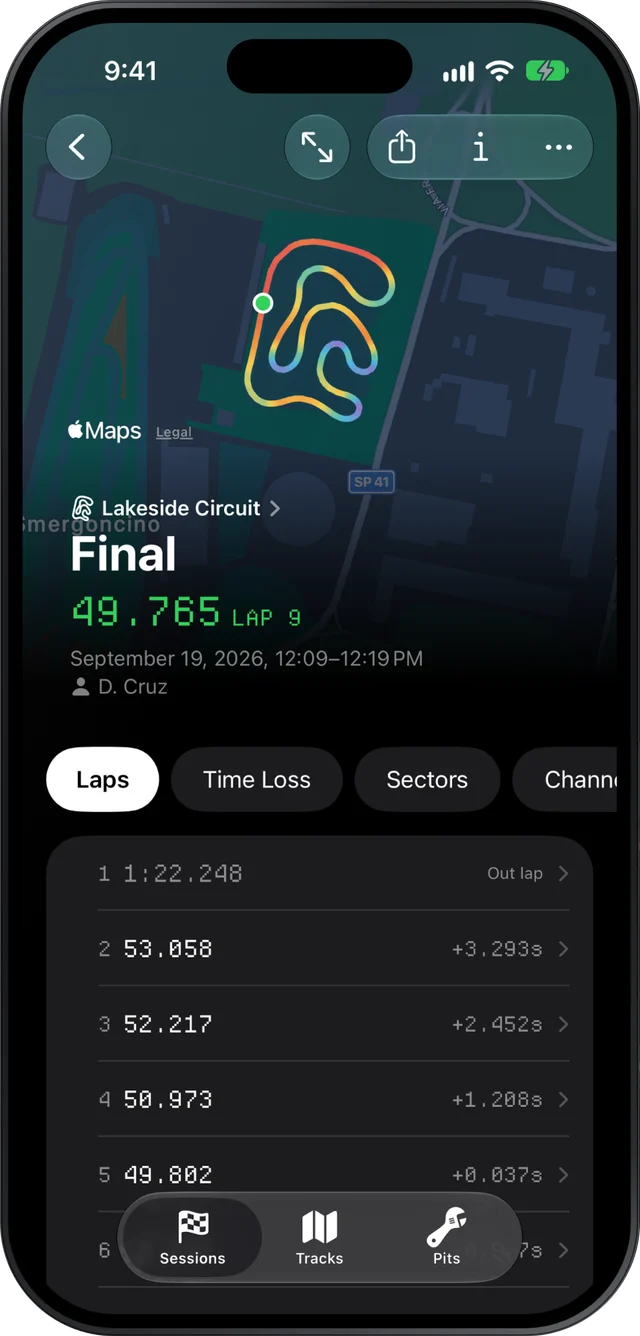
Slicks opens the XRK or XRZ file from the MyChron on your Rok GP kart and, on the session's Setup page, checks the peak exhaust temperature against 450–650 °C and the peak water temperature against 48–60 °C, in plain words as well as colour. Peak RPM is shown without a verdict, because Slicks has no RPM window for the Rok.
The Rok GP and where it is raced
The Rok GP is Vortex's 125 cc, water-cooled, reed-valve two-stroke with an electric starter. It is the engine of the ROK Cup classes: Senior ROK runs it, and juniors run a junior version of it. At the big ROK events the engines are sealed and checked, and the weekend runs through qualifying, heats, a prefinal and a final, often on progressive grids where every heat result moves you up or down for the next.
A sealed engine narrows what you can change. You cannot open it up between heats, so the work is jetting, gearing and the kart. That is why the temperatures matter so much on a Rok: the carb is the one engine adjustment you have, and the exhaust and water readings are how you know whether it was the right one.
What Slicks checks for a Rok GP
Pick Vortex Rok GP under Pits, and every session's Setup page reads like this:
| Reading | The window Slicks checks against | What you get |
|---|---|---|
| Peak exhaust gas temperature | 450–650 °C | A verdict in words and colour |
| Peak water temperature | 48–60 °C | A verdict in words and colour |
| Peak RPM | none | The number, without a verdict |
These are the ranges the karting community quotes for the Rok GP, not Vortex's specifications. The numbers quoted for Vortex engines vary from source to source (you will also see 600–680 °C for Vortex exhaust temperatures), so if your engine builder gave you a range, theirs wins. Slicks has no custom windows yet. When your tuner's numbers differ from the preset, read the number, not the colour.
Reading the exhaust temperature properly
The peak on the Setup page is one number: the hottest moment of the session. That is a good first check and a poor last word. A single spike at the top of the revs can set it, and one long straight can read hotter than the rest of the lap.
So when the verdict says the exhaust ran hot or cold, look at where:
- Tap the fastest lap. The lap screen charts every reading against one distance axis, EGT included.
- Scrub along the main straight. Karters who tune by data watch the exhaust temperature climb along a straight; if it falls there, the engine is usually running lean.
- Hold the map at the end of the straight to read the exact temperature at that point.
- Check one or two other laps. A peak that shows up once is a spike. One that shows up every lap is the jetting.
Air changes through the day, so a jetting that was right in the morning can be wrong by the afternoon. Write each carb change in the session's setup when you import the next file, so the temperature that follows sits on the same page as the change that caused it.
Water temperature through a ROK weekend
The window Slicks checks is wide, 48–60 °C, because the numbers karters quote for the Rok run from the high 40s on a hot day to the high 50s when it is cold. Where you sit in it depends on the weather more than on anything you do in the pits, apart from tape on the radiator.
On a cold morning a Rok can spend the first laps below the window. Setup also lists every channel's lowest and highest reading: if the water's lowest is far under its highest, the engine took a good part of the session to warm up, and the early laps were not run at its best temperature. Tape goes on, the next session's range closes up, and you can see it did. Put "tape, half the radiator" in Notes so you remember what the number was answering.
RPM and gearing without a window
Slicks does not judge the Rok's peak RPM, but it still records it, and the lap screen charts RPM against distance like every other channel. That is enough to read gearing by comparison:
- Does the RPM trace go flat before the end of the longest straight? The gearing may be too short.
- Does it never get near the revs where your engine builder says the Rok pulls best? It may be too tall.
- After a sprocket change, does the peak on the Setup page move the way you expected?
Log the sprocket teeth, front and rear, in the session's setup. Our page on reading gearing from the RPM trace goes through it step by step, and exhaust and water temperature covers the readings for every engine.
A routine for heat day
Between heats there is no time for a deep read. Four checks:
- Setup page. Exhaust and water against the window. Anything outside it goes to your tuner first.
- Sectors. Best lap against the theoretical best. Has the gap closed since the last heat?
- Time Loss. The top corner, and whether the braking point moved.
- One change, written down. Carb, gearing or pressures, never two at once.
The beginner's guide to reading kart telemetry explains each of those screens if you are new to them.
What Slicks does not do for a Rok racer: it has no RPM window for the engine and no custom windows, it does not download from the MyChron (the file comes off with AiM's own tools first), and it compares laps within one session, not two sessions against each other.
